Research protocol
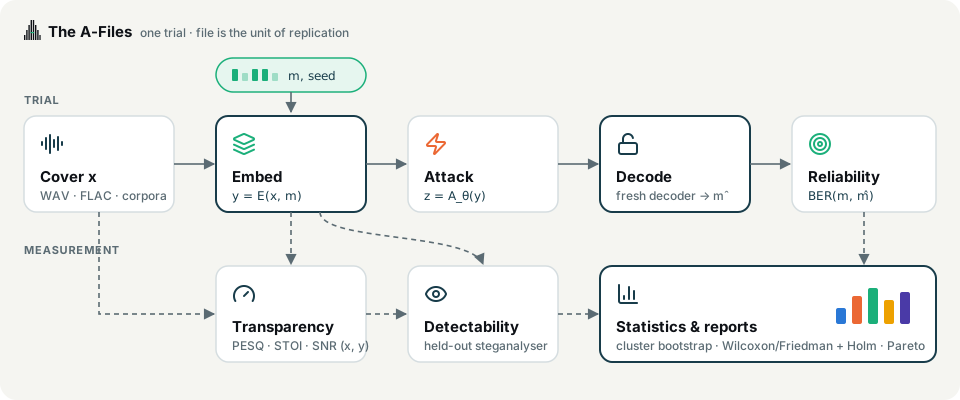
Information hiding in audio is governed by four mutually conflicting requirements: payload capacity, perceptual transparency, robustness to signal processing, and — in the steganographic setting — statistical undetectability. No single method dominates on all four axes, and published results are frequently obtained under incomparable conditions (different corpora, payload sizes, attack parameters and metric implementations). The A-Files addresses this by evaluating methods under a shared, recorded experimental protocol. See the taxonomy and trade-offs in Alsabhany et al..
Let x[n] denote a cover speech signal sampled at f_s, and b ∈ {0,1}^L a binary payload of length L. An embedding
function E produces the stego signal
which may be subjected to a channel or attack operator A_θ with explicit parameters θ, yielding z[n] = A_θ(y[n]).
A blind decoder D recovers an estimate b̂ = D(z[n], L) without access to the cover. Each trial is characterised by:
- Reliability — bit error rate
BER = (1/L) Σ 1[b_i ≠ b̂_i]and bit accuracy1 − BER; - Transparency — objective distortion between
xandy(e.g. SNR, PESQ, STOI), computed before the attack so that embedding distortion is not confounded with attack damage; - Robustness — BER as a function of the attack family and its severity
θ; - Capacity — the largest
Lfor which decoding remains error-free on a segment of given duration; - Detectability — held-out accuracy of a cover-versus-stego classifier (steganalysis).
The toolkit comprises:
- 30 embedding implementations and adapters spanning time-domain, transform-domain (DCT, DWT, LWT, SVD, EMD), spread-spectrum, quantisation-index-modulation, echo, phase, reversible and neural approaches;
- 25 registered quality/intelligibility metrics, including eSTOI, spectral diagnostics and optional ViSQOL Audio;
- a library of seeded, parameterised attacks grouped by physical phenomenon, with severity presets and composite channel pipelines;
- a steganalysis module estimating empirical detectability;
- an asynchronous experiment engine that produces normalised, exportable result tables.
Signal and payload representation
Audio is represented as a discrete-time waveform with its sampling rate and container metadata. WAV, FLAC and OGG are
supported. Two public speech corpora are bundled as fixed subsets — VCTK (10 utterances) and LibriSpeech (11
utterances) — so that experiments can be repeated without external downloads. Payloads are binary vectors, which
decouples each method's encode/decode interface from the storage format.
Experiments also accept exact UTF-8 text, hexadecimal bytes, explicit bits and seeded random payloads at requested bit rates. Rows record exact bit counts, offered bits/s, bits/sample, exact-message goodput, runtime factors, audio metadata and payload/audio hashes. Exported run configurations pin the selected relative file paths and SHA-256 digests. The Statistics tab offers filtered research comparisons. See the research protocol and examples for metric definitions, payload conventions, dataset metadata, sources, implementation scope and validation.
Method contract
Every method is subject to an automated conformance test on real speech from the bundled VCTK subset. The test asserts
that (i) the payload is recovered bit-exactly by a fresh decoder instance, so no state is shared between encoder and
decoder; (ii) encode neither modifies the caller's cover nor changes its length; (iii) a payload exceeding the
method's capacity raises CapacityError (a subclass of ValueError, in taf.models.errors) instead of being silently
truncated, both just above the capacity of frame-based methods and above four bits per sample, which no packaged method
can carry; and (iv) encoding and decoding are numerically stable on synthetic signals. The experiment engine relies on
(i) and (iii): extraction always runs on a new instance, and CapacityError is recorded as an over-capacity outcome
rather than as a crash. Several methods derive embedding strength or quantisation steps from local signal
statistics, such as frame norm or band RMS. Gain robustness depends on the method and processing chain; it
is measured experimentally rather than assumed for the entire catalogue. Optional-model tests may be skipped
when dependencies or weights are unavailable. Conformance checks cover selected inputs and parameter settings.